







Slay the Spire is one of the most addictive and intelligent roguelike deck-building games ever created. Developed by Mega Crit, the game combines strategy, card management, random encounters, and tactical decision-making into a constantly evolving experience where no two runs feel the same. Every climb up the Spire presents new challenges, different relic combinations, and unexpected situations that force players to adapt rather than rely on one strategy forever.
At first, the game may appear simple. You play cards, attack enemies, block damage, and choose rewards after battles. However, after several runs, most players realize that Slay the Spire is far deeper than it initially seems. Success depends on understanding efficiency, deck consistency, scaling, energy management, and long-term planning. Small decisions made early in a run can completely determine whether you dominate the final boss or collapse halfway through Act 2.
This detailed guide explains how to improve at every stage of the game, from early survival to advanced deck-building strategies. Whether you are completely new or already attempting Ascension levels, learning these principles will dramatically improve your performance and consistency.
1. How to Understand the Core Gameplay Loop
The core structure of Slay the Spire revolves around climbing floors while gradually improving your deck. Every run begins with a weak starter deck and limited resources. As you progress upward, you encounter enemies, events, treasure rooms, merchants, campfires, and powerful bosses. Each decision affects the strength and direction of your build.
Unlike many card games, Slay the Spire is not about collecting as many powerful cards as possible. The game rewards efficiency and synergy far more than raw quantity. A small deck with reliable combinations is usually much stronger than a large deck filled with random cards that do not support each other.
One of the most important concepts to understand is that health acts as a resource. New players often play too defensively and avoid taking risks. However, sacrificing small amounts of health to gain stronger relics or upgrades can make your deck dramatically stronger later. Elite fights, for example, are dangerous but provide relics that often become the foundation of successful runs.
Another important aspect is adaptability. Many players lose because they attempt to force a specific archetype every game. Since rewards are randomized, strong players learn how to adapt their decks according to relics, card rewards, and enemy encounters rather than chasing the same strategy repeatedly.
Important Core Concepts
- Health is a resource, not just a survival bar
- Smaller decks are usually more consistent
- Relics are often more valuable than cards
- Adaptation is more important than forcing builds
- Long-term scaling matters more than early power

2. How to Build a Strong Start in Act 1
Act 1 determines the foundation of your entire run. Early mistakes can create weak scaling that becomes impossible to recover from later. Your goal during this phase is to increase your deck’s immediate power while preparing for Elite encounters and the Act boss.
Many beginners avoid Elite enemies because they are dangerous. While caution is understandable, avoiding all Elite fights usually results in weak relic generation and poor scaling. Relics are among the strongest power boosts in the game, and Elite enemies are one of the primary ways to obtain them.
Early in Act 1, direct damage cards are especially valuable. Starter decks often lack enough offensive power to defeat enemies efficiently. Taking strong attack cards early helps shorten battles and reduce incoming damage overall.
At the same time, route planning becomes extremely important. Before beginning a run, study the map carefully. A good route usually includes normal battles for card rewards, at least one Elite encounter, and campfires for upgrades or healing. Flexible paths are ideal because they allow you to adjust based on your health and deck strength.
Common Act 1 Mistakes
- Taking too many defensive cards early
- Avoiding Elite fights entirely
- Resting too frequently instead of upgrading
- Adding weak cards just because they are offered
- Ignoring long-term synergy planning
3. How to Build Consistent Decks
Deck consistency is one of the most important skills in Slay the Spire. Many inexperienced players believe every card reward should be accepted, but this often weakens the deck by reducing draw consistency.
A smaller deck allows important cards to appear more frequently. If your strongest scaling card only appears once every several turns because your deck is overloaded with unnecessary cards, your overall efficiency drops significantly.
Successful decks usually revolve around a clear game plan. Some builds focus on poison scaling, while others rely on Strength gain, orb generation, combo loops, or defensive scaling. Strong synergy matters far more than individual card power.
Card removal is also extremely valuable. Removing weak starter Strikes and Defends improves draw quality and increases the consistency of stronger cards. Shops and events that remove cards are often more impactful than adding new ones.
Another important lesson is learning when to skip card rewards entirely. Many strong players skip cards frequently because unnecessary additions weaken deck focus.
Signs of a Strong Deck
- Reliable damage scaling
- Consistent defense generation
- Balanced energy costs
- Strong synergy between cards
- Efficient card draw and cycling
4. How to Master Each Character
Every character in Slay the Spire offers unique mechanics and strategies. Understanding their strengths and weaknesses is essential for consistent success.
Ironclad
The Ironclad is the most beginner-friendly character because of his high health pool and passive healing after combat. He specializes in Strength scaling, heavy attacks, and Exhaust mechanics.
Many new players underestimate Exhaust cards, but they become incredibly powerful later. Exhaust strategies allow the Ironclad to remove weak cards during combat while generating massive value through relics and synergies.
The Ironclad excels at aggressive scaling. Strength builds can quickly become overwhelming if supported properly.
Silent
The Silent focuses on poison, agility, card draw, and defensive manipulation. While she has lower starting health, she compensates with excellent utility and scaling options.
Poison builds are among the most reliable strategies in the game because poison bypasses enemy block and scales naturally over time. However, surviving early battles can be difficult because poison often requires setup before becoming effective.
The Silent also has access to some of the best defensive tools in the game. Dexterity scaling combined with efficient block cards can create extremely durable builds.
Defect
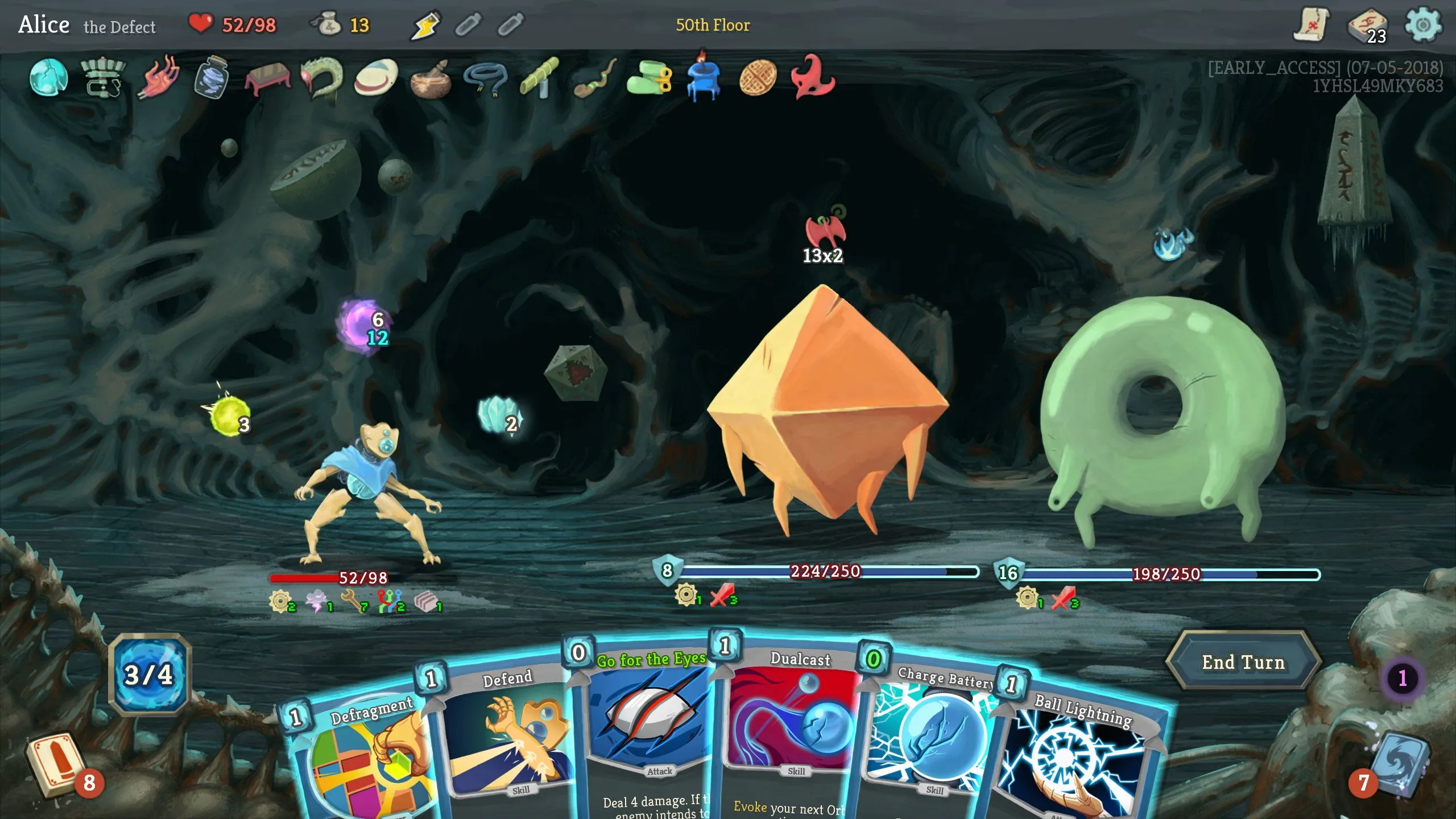
The Defect revolves around elemental Orbs and Focus scaling. This character has one of the highest power ceilings in the game but requires deeper understanding to use effectively.
Lightning orbs provide passive damage, Frost orbs generate defense, and Dark orbs offer massive burst damage potential. Learning when to channel, evoke, or preserve orbs is crucial.
Focus generation dramatically improves orb effectiveness, making it one of the most important stats for Defect builds.
Watcher
The Watcher is arguably the strongest character in the game but also one of the riskiest. Her stance system allows enormous damage output through Wrath stance, which doubles attack damage dealt and received.
This creates explosive combat potential but punishes mistakes heavily. Proper stance switching and energy management are essential for survival.
Experienced players often dominate with the Watcher because of her incredible burst damage and combo potential.
5. How to Use Relics Effectively
Relics are one of the defining systems of Slay the Spire. A single relic can completely change how a run plays out.
Energy relics are especially powerful because additional energy increases flexibility every turn. However, some energy relics come with dangerous drawbacks, so choosing correctly depends on your deck’s needs.
Many relics create powerful synergies with certain builds. For example, relics that improve Strength generation work extremely well with aggressive Ironclad decks, while card draw relics greatly benefit combo-heavy strategies.
Elite fights are important largely because relic acquisition creates exponential scaling over time. A deck with strong relic synergy often feels dramatically more powerful even without many rare cards.
Strong Relic Categories
- Energy relics
- Card draw relics
- Defensive scaling relics
- Combo-enhancing relics
- Healing and sustain relics
6. How to Manage Energy and Card Economy
Efficient energy management is one of the biggest differences between average and advanced players.
Every turn represents an opportunity to maximize value. Unused energy often means wasted potential. However, filling a deck entirely with expensive cards creates awkward hands and inconsistent turns.
Balanced decks usually contain a mix of:
- Cheap utility cards
- Mid-cost scaling cards
- High-impact finishers
Card draw becomes increasingly important later because it improves consistency and flexibility. Drawing more cards allows players to find critical combo pieces faster while avoiding dead turns.
Many advanced strategies rely heavily on energy generation combined with card draw loops. When properly balanced, these systems create extremely powerful scaling engines.
Energy Management Tips
- Avoid overcrowding decks with expensive cards
- Prioritize flexibility over raw power
- Value card draw highly
- Build around your available energy generation
7. How to Defeat Elite Enemies and Bosses
Elite enemies and bosses act as major skill checks throughout the game. Each one tests different aspects of your deck.
Some bosses punish weak scaling, while others punish overreliance on powers or poor defense. Preparing for future encounters is one of the most strategic aspects of Slay the Spire.
Learning enemy patterns is extremely important. Every enemy follows predictable behaviors, and understanding these patterns allows you to optimize block timing, setup turns, and potion usage.
Potions are another frequently underestimated resource. Many beginners save potions for too long and die with unused items still available. Strong players use potions aggressively to secure difficult fights and maintain momentum.
Boss Preparation Checklist
- Consistent scaling damage
- Reliable defensive options
- Enough upgraded cards
- Balanced energy economy
- Emergency potion support

8. How to Scale Into Late Game
Late-game enemies require scaling. Basic attacks and simple block cards stop being effective by themselves.
Scaling refers to your deck’s ability to become stronger over time during combat. Different characters achieve this through different methods:
- Strength gain
- Poison stacking
- Focus generation
- Dexterity scaling
- Infinite loops
Without scaling, late-game bosses eventually overpower your deck regardless of early-game success.
At the same time, balancing setup speed and survival is critical. A deck that scales infinitely but dies before scaling begins is useless.
Strong Late-Game Priorities
- Reliable scaling engines
- Sustainable defense
- Efficient card draw
- Energy consistency
- Synergistic relic combinations
9. How to Improve Decision-Making
One of the biggest skills in Slay the Spire is learning how to make disciplined decisions.
Strong players constantly evaluate:
- Risk versus reward
- Short-term survival versus long-term scaling
- Current deck weaknesses
- Future boss requirements
Many losses happen because players become greedy. Taking unnecessary cards, risky Elite fights without preparation, or expensive relics that do not fit the build can quickly destroy promising runs.
Learning when to skip rewards is just as important as knowing when to accept them.
Improvement comes through reflection. After every loss, ask:
- Why did my deck fail?
- Did I lack scaling?
- Was my defense inconsistent?
- Did I overload my deck?
Understanding mistakes accelerates long-term improvement dramatically.
10. How to Win Consistently on Higher Ascensions
Ascension levels increase difficulty significantly and force players to optimize every aspect of gameplay.
At higher Ascensions:
- Enemies deal more damage
- Healing becomes weaker
- Deck consistency matters more
- Greedy decisions become heavily punished
Winning consistently requires disciplined deck-building, strong pathing decisions, and efficient resource management.
Experienced players understand that Slay the Spire is not about chasing perfect builds every run. Instead, success comes from adapting intelligently to random rewards and maximizing the strengths available.
Consistency ultimately matters more than flashy combos. A reliable deck with balanced offense and defense usually outperforms unstable high-risk strategies over time.
High-Level Improvement Tips
- Learn enemy attack patterns
- Prioritize consistency
- Build around relic synergy
- Avoid unnecessary cards
- Adapt instead of forcing archetypes
Conclusion
Slay the Spire remains one of the best strategy roguelikes ever created because every run feels different while still rewarding skill, planning, and intelligent decision-making. The game constantly challenges players to balance aggression, defense, scaling, and efficiency while adapting to unpredictable rewards and encounters.
Mastering the game takes time, but understanding core concepts like deck consistency, relic synergy, energy management, and scaling dramatically improves your performance. Every failed run teaches valuable lessons, and long-term success comes from learning how to adapt rather than relying on one fixed strategy.
Whether you prefer the raw power of the Ironclad, the poison tactics of the Silent, the orb mastery of the Defect, or the explosive combos of the Watcher, Slay the Spire offers nearly endless strategic depth for players willing to learn its systems.
Summary (160 characters):
Master Slay the Spire with advanced deck-building, scaling, relic synergy, and combat strategies to improve consistency and win more runs.