.webp)
Who’s Your Daddy?!: The World’s Worst Babysitter — When an Ordinary House Becomes a Comedy of Chaos

Imagine a peaceful afternoon at home. The dishes are clean, the garden is quiet, and the baby is sitting exactly where you left them.
Then you look away for three seconds.
Suddenly, the kitchen has become a disaster zone, the living room is suspiciously quiet, and you are sprinting across the house wondering how a normal day turned into an emergency.
Welcome to Who’s Your Daddy?!, a multiplayer comedy game that transforms the familiar household into a ridiculous battle of attention, mischief, and survival. One player takes on the role of a father trying to protect his infant son, while another plays the baby, exploring the house and attempting to outsmart every protective measure. With more than 67 potentially dangerous household objects, unpredictable physics, and randomized item locations, no two rounds need to unfold the same way.
But the real magic of Who’s Your Daddy?! is not simply its objective. It is the collection of absurd stories that emerge when two players have completely opposite ideas about what should happen next.

1. The House Is the Main Character
In most games, a house is a safe place between missions. In Who’s Your Daddy?!, the house deserves its own cast credit.
The two-story home and garden are filled with everyday objects that can turn an ordinary room into the center of a chaotic situation. A kitchen is no longer just a kitchen. A bathroom is not necessarily a place to relax. Even the garden can become the setting for an unexpected crisis.
Every Room Has a Different Comedy Style
The Kitchen: Domestic Disaster
This is where ordinary household routines can quickly spiral out of control. The father might be trying to keep dangerous items out of reach while the baby investigates everything that looks interesting.
The Living Room: The False Sense of Security
The father believes the baby is occupied. The baby has other plans. It is the perfect setting for a quiet moment that becomes suspiciously chaotic.
The Bathroom: A Plumbing Emergency Waiting to Happen
Water-related objects can introduce a different kind of trouble. A simple attempt to manage the room may turn into an unexpected cleanup operation.
The Garden: Freedom with Consequences
The outdoors offers more space to explore, but more space does not automatically mean fewer problems.
Let the Setting Create the Joke
The funniest moments often begin with a normal intention.
The father wants to finish a task. The baby wants to investigate something. Both players act on their plans, and the house produces a result neither expected.
That is the central joke of the game: the environment looks familiar, but its possibilities are anything but ordinary.
2. Daddy: The Only Employee in a One-Person Emergency Department
Playing as Daddy is a job with an impossible description.
You are responsible for protecting your baby, monitoring the house, securing dangerous objects, and reacting to whatever strange plan is unfolding. The problem is that you cannot be everywhere at once.
Your opponent, meanwhile, has an extraordinary talent for finding trouble the moment your attention moves elsewhere.
The Three Stages of Daddy's Emotional Journey
Stage One: Confidence
You inspect the house, secure a few dangerous objects, and convince yourself that you have everything under control.
Stage Two: Suspicion
The baby is suddenly missing from the place where you expected them to be. A sound comes from another room. You begin to question every decision you have made.
Stage Three: Full-Time Panic
You abandon your original plan and rush to deal with the latest emergency. Any idea of a peaceful afternoon is officially over.
Why the Daddy Role Is Funny
The father is not necessarily losing because he lacks intelligence. He is losing because he has too many responsibilities and too little time.
Every decision involves a trade-off. Secure one room, and another becomes harder to monitor. Follow the baby, and you may overlook an object elsewhere. Try to prepare everything in advance, and the situation may change before you finish.
The role creates a comedy of divided attention: the more seriously you take your responsibilities, the more entertaining the inevitable chaos becomes.
3. Baby: Small Body, Absolutely No Respect for the Schedule
If Daddy represents responsibility, the baby represents curiosity without a functioning risk assessment system.
The baby explores the house, interacts with its objects, and tries to overcome Daddy's attempts to keep everything under control. The contrast between the two roles is what gives the game its central competitive tension.
Think Like a Mischievous Cartoon Character
The baby does not need a complicated master plan. The appeal comes from exploring, improvising, and taking advantage of the moments when Daddy is distracted.
A room that appears completely secure may become interesting simply because Daddy has moved somewhere else.
An object that seems unimportant might become the center of the next encounter.
A quiet moment can be the perfect setup for an unexpected change of direction.
The Art of Creating Suspense
The baby role works best when the father cannot predict what will happen next.
Sometimes the funniest choice is to explore an overlooked corner. Sometimes it is to change direction at the last second. Sometimes the comedy comes from the father becoming so focused on one problem that another opportunity opens elsewhere.
The result is a game of competing attention spans, where curiosity constantly challenges control.
4. The Household Object Hall of Fame
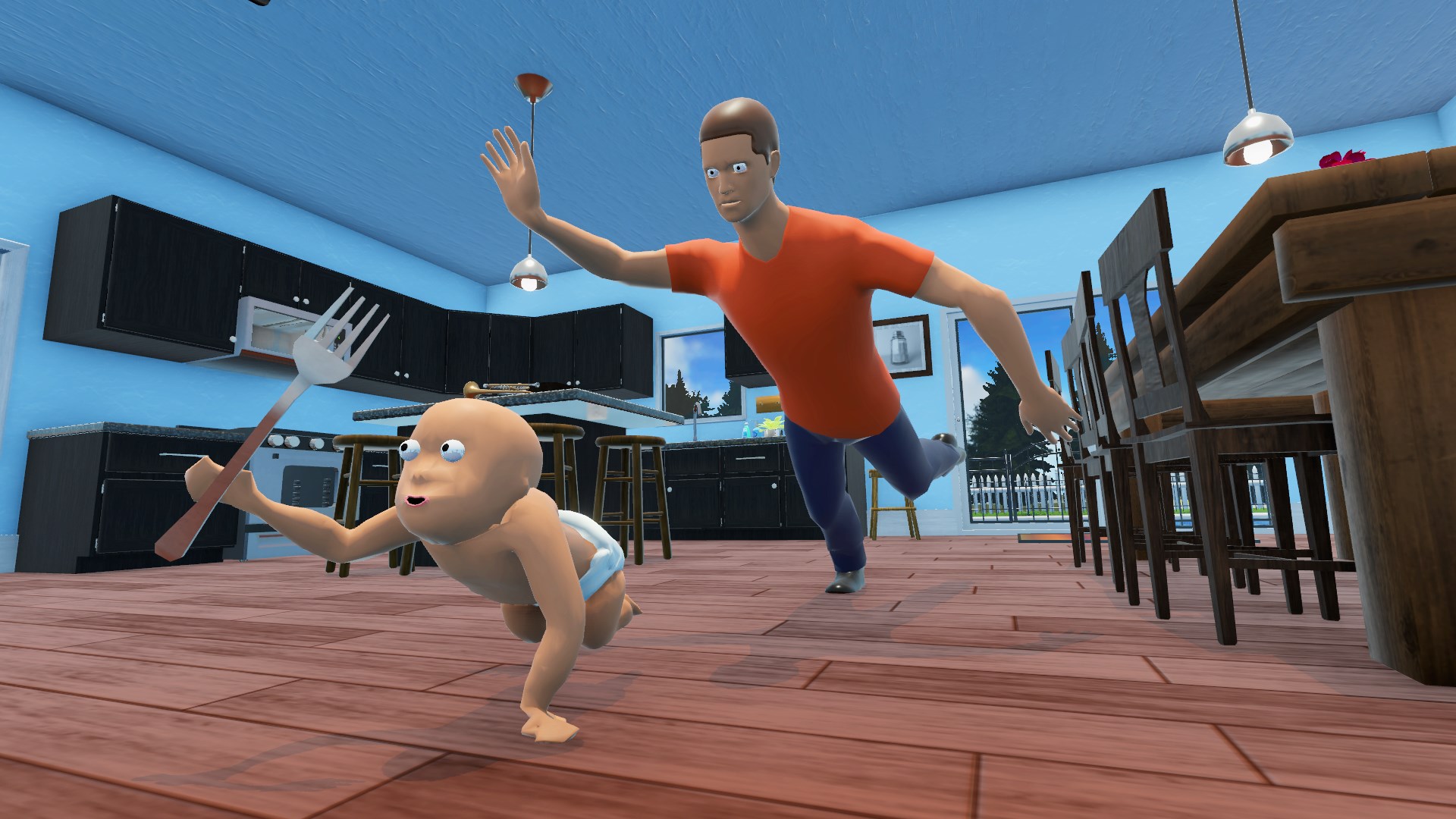
One of the game's most memorable features is the sheer number of everyday objects that can become sources of danger or comedy. The official game description includes items such as power outlets, sinks, a nail gun, an oven, a swimming pool, a blender, and even a rideable dog named Fudge.
These objects are funny because they belong to familiar environments. Their presence feels normal until the game's exaggerated premise turns them into the center of a ridiculous situation.
Ordinary Objects, Extraordinary Problems
The Power Outlet
A reminder that Daddy cannot ignore even the smallest details when trying to keep the house safe.
The Sink
An everyday fixture that can become a source of unexpected water-related chaos.
The Oven
A normal part of a kitchen that suddenly feels much more important when Daddy is trying to prevent trouble.
The Swimming Pool
A place associated with relaxation that becomes another area requiring attention.
Fudge the Dog
A memorable household companion whose unusual role adds another layer of absurdity to the game's world.
Why These Objects Work So Well
The game does not need an alien invasion or a supernatural monster to create tension. It uses familiar household items and asks players to treat them as potential sources of chaos.
That contrast makes every room feel a little unpredictable.
The player already understands what a kitchen or a garden is supposed to be. The fun comes from discovering how quickly the game's unusual rules can turn that familiar environment into something completely different.
5. Every Match Is a New Episode of the Same Terrible Sitcom
A comedy game can lose its charm if every round unfolds exactly the same way. Who's Your Daddy?! helps avoid that problem with randomized locations for crucial items, customizable game modes, and physics-driven interactions.
The rules and setting provide a familiar framework, but the details can change from one match to another.
Think in Episodes, Not Repetitions
Every round can have its own theme:
- The Overconfident Parent: Daddy believes the house is completely secure.
- The Great Distraction: Daddy becomes so focused on one room that the rest of the house feels neglected.
- The Unexpected Detour: A simple trip through the house turns into a completely different situation.
- The False Victory: Daddy believes the danger has passed, only for another problem to appear.
- The House That Fights Back: Physics turns an ordinary interaction into a chain reaction.
These are storytelling ideas rather than official game modes. They can help you and your friends give each match its own personality.
Let Randomness Write the Script
Do not worry about reproducing a perfect sequence of events.
The game is most entertaining when players react naturally to what happens. A small mistake, an unexpected collision, or a badly timed decision can become the highlight of the entire session.
Sometimes the best episode is the one nobody planned.
6. Why Playing with Friends Makes Everything Worse—in the Best Way
Who's Your Daddy?! supports online and local multiplayer, allowing you to play with up to seven friends. That social setup is especially suited to a game built around opposing objectives and unpredictable situations.
The experience changes dramatically when players can communicate, bluff, panic, and react to one another in real time.
The Daddy-Baby Relationship Is Perfect for Comedy
One player is trying to prevent a disaster. The other is trying to outmaneuver those efforts.
That creates natural opportunities for funny exchanges:
- Daddy insists that everything is under control.
- The baby immediately challenges that claim.
- Daddy rushes to deal with a problem.
- The baby discovers a new way to complicate the situation.
- Both players blame the physics when their plans fail.
Make the Session About the Stories
Instead of focusing only on who wins, pay attention to the moments that emerge along the way.
Who made the most questionable decision? Who spent the entire round looking in the wrong place? Who caused a chain reaction that nobody could explain afterward?
These stories give friends a reason to remember the match long after the round ends.
7. Physics Is the Uncredited Comedian
In many competitive games, players expect movement and object interactions to behave consistently. Who's Your Daddy?! embraces wacky physics as part of its identity.
That means a situation can become funny even when neither player deliberately tries to create a joke.
An interaction happens at an awkward angle. A character moves unexpectedly. A plan falls apart because the environment does something nobody anticipated.
The Three Ingredients of a Physics Joke
Expectation
A player expects an object or character to behave in a particular way.
Interruption
The physics produces an unexpected result.
Reaction
The player attempts to recover, often making the situation even more ridiculous.
This pattern is one reason the game works so well as a shared experience. Players are not simply watching a scripted joke. They are creating the setup and discovering the punchline together.
Learn to Laugh at the Failed Plan
When something unexpected happens, the instinct may be to immediately regain control.
Sometimes that is necessary if you want to win. But it is also worth appreciating how the unexpected outcome changes the match.
The physics system is part of the game's personality. A perfectly executed plan may be satisfying, but a spectacularly failed plan can become the story everyone remembers.
8. The Secret to a Great Session Is Controlled Chaos
It might seem strange to discuss control in a game designed around absurdity, but the best multiplayer comedy often comes from a balance between structure and unpredictability.
If nothing makes sense, players may become confused. If everything is predictable, the experience can become repetitive.
Who's Your Daddy?! works by giving both players a clear objective while allowing the household, randomized items, and physics to complicate the route toward that objective.
Create Your Own House Rules
Customizable game modes let players adjust aspects of the experience. You can also agree on informal rules to make a session feel different.
For example:
- Play several rounds before switching roles.
- Give each player a silly nickname for the session.
- Treat every unexpected event as part of an imaginary sitcom.
- Award a playful title for the funniest mistake.
- Let the losing player choose the theme for the next round.
These are suggestions for organizing a session, not built-in game features.
Keep the Competition Friendly
The game is at its best when players are willing to laugh at their own mistakes. If every failed attempt becomes an argument, the comedy loses its appeal.
The objective is to outsmart the other player, but the memorable moments often come from situations where both players end up surprised by the result.
9. Turn Your Match into a Story Worth Retelling
Some games are remembered for their achievements, difficult bosses, or impressive victories. Who's Your Daddy?! can also be remembered for a single ridiculous sequence that nobody expected.
That makes it particularly well suited to storytelling and funny gameplay clips.
Give Each Round a Beginning, Middle, and End
The Setup
Daddy believes the house is secure, and the baby appears to be behaving.
The Escalation
A small distraction leads to another problem. Daddy begins moving between rooms, and the situation becomes increasingly difficult to manage.
The Payoff
The round reaches its conclusion, leaving both players with a moment that feels like the final scene of a comedy sketch.
You do not need to plan these moments in advance. This framework is simply a way to recognize the natural story that emerges during a match.
Capture the Reaction, Not Just the Outcome
If you record gameplay, the funniest moment may not be the final result. It may be the split second when Daddy realizes something has gone wrong, or when the baby unexpectedly escapes a situation that looked completely hopeless.
A good clip communicates both what happened and how the players reacted.
That human response is often what makes a chaotic moment genuinely entertaining.
10. The Real Winner Is Whoever Creates the Best Disaster
At first glance, Who's Your Daddy?! is a competition between two opposing roles. Daddy tries to keep the baby safe, while the baby attempts to overcome Daddy's efforts.
But the experience offers something beyond a simple win-or-lose outcome.
It creates a space where ordinary objects become sources of suspense, physics becomes an unexpected comedian, and friends can turn a routine match into a story full of surprises.
Measure a Match by More Than Its Result
A satisfying session might include a clever defensive decision, a successful escape, a hilarious mistake, or a moment when both players completely lose control of the situation.
Winning is part of the game, but the memorable moments often come from everything that happens on the way to the result.
That is why a match can remain entertaining even when your original plan fails.
Embrace the Absurdity
Do not expect every round to unfold logically.
Do not assume the house will remain peaceful.
And do not trust a quiet moment simply because nothing has gone wrong yet.
In Who's Your Daddy?!, chaos is not a break from the experience.
Chaos is the experience.
Conclusion: Parenting Has Never Been This Ridiculous
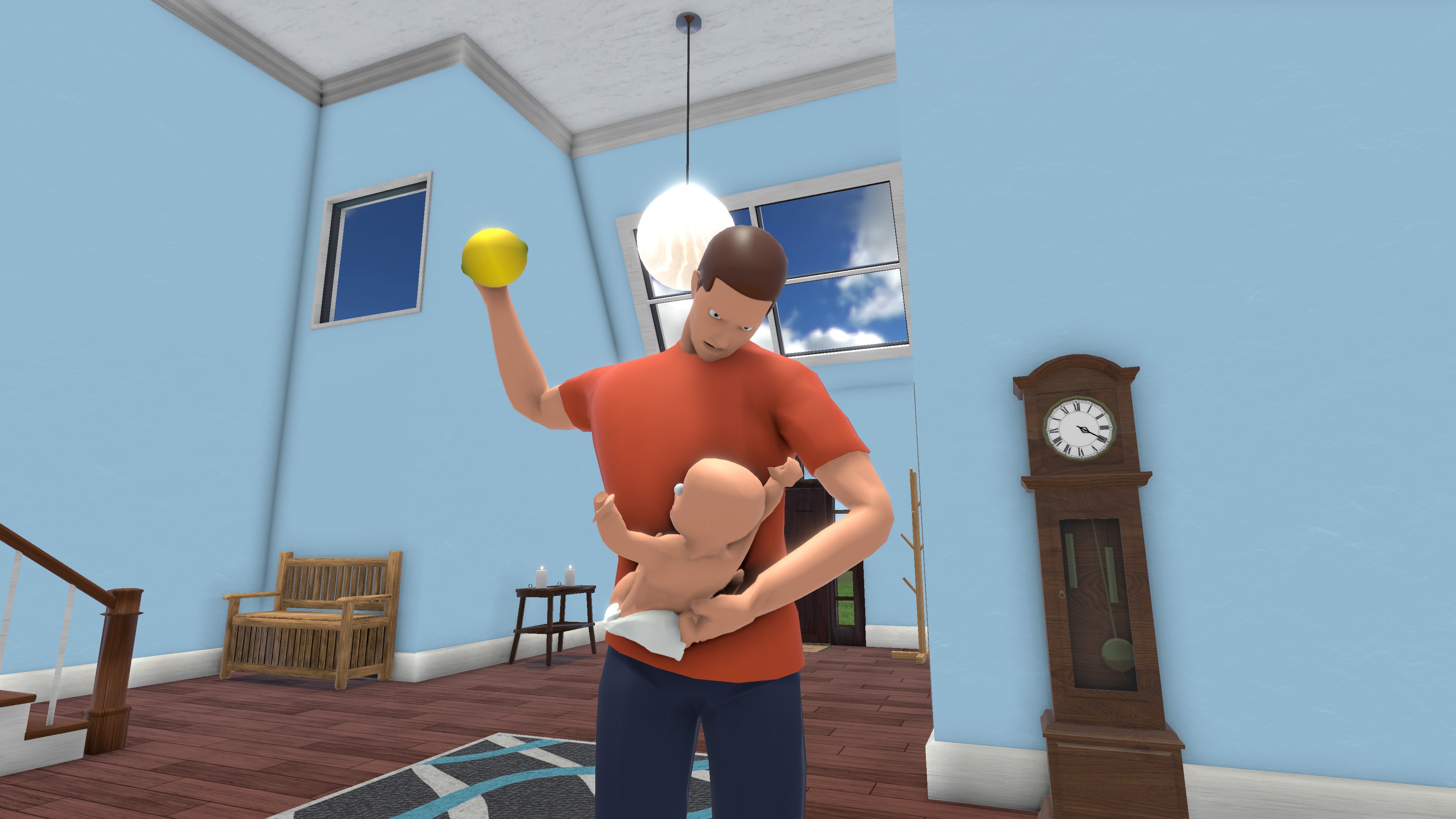
Who's Your Daddy?! takes a familiar setting and turns it into an unpredictable multiplayer comedy. The two-story home and garden, more than 67 potentially dangerous household items, randomized item locations, customizable game modes, and physics-driven interactions create a framework for endless ridiculous situations.
Its greatest strength is the contrast between the two roles. Daddy wants order, safety, and control. The baby wants to explore and challenge those efforts. Every encounter between these opposing goals creates the possibility of another unexpected story.
That is what makes the game more than a collection of household hazards. It is a comedy built from player decisions, imperfect plans, and reactions that cannot be scripted.
So gather your friends, choose your role, and enter the house with realistic expectations.
Daddy may have a plan. The baby may have a plan. But the physics has its own ideas.
And in this house, the physics usually gets the last laugh.